Cellular Longevity
MOTS-c
Mitochondrial-Derived Peptide — Exercise Capacity & Metabolic Health
| Supplier | Form | Pack | Price | |
|---|---|---|---|---|
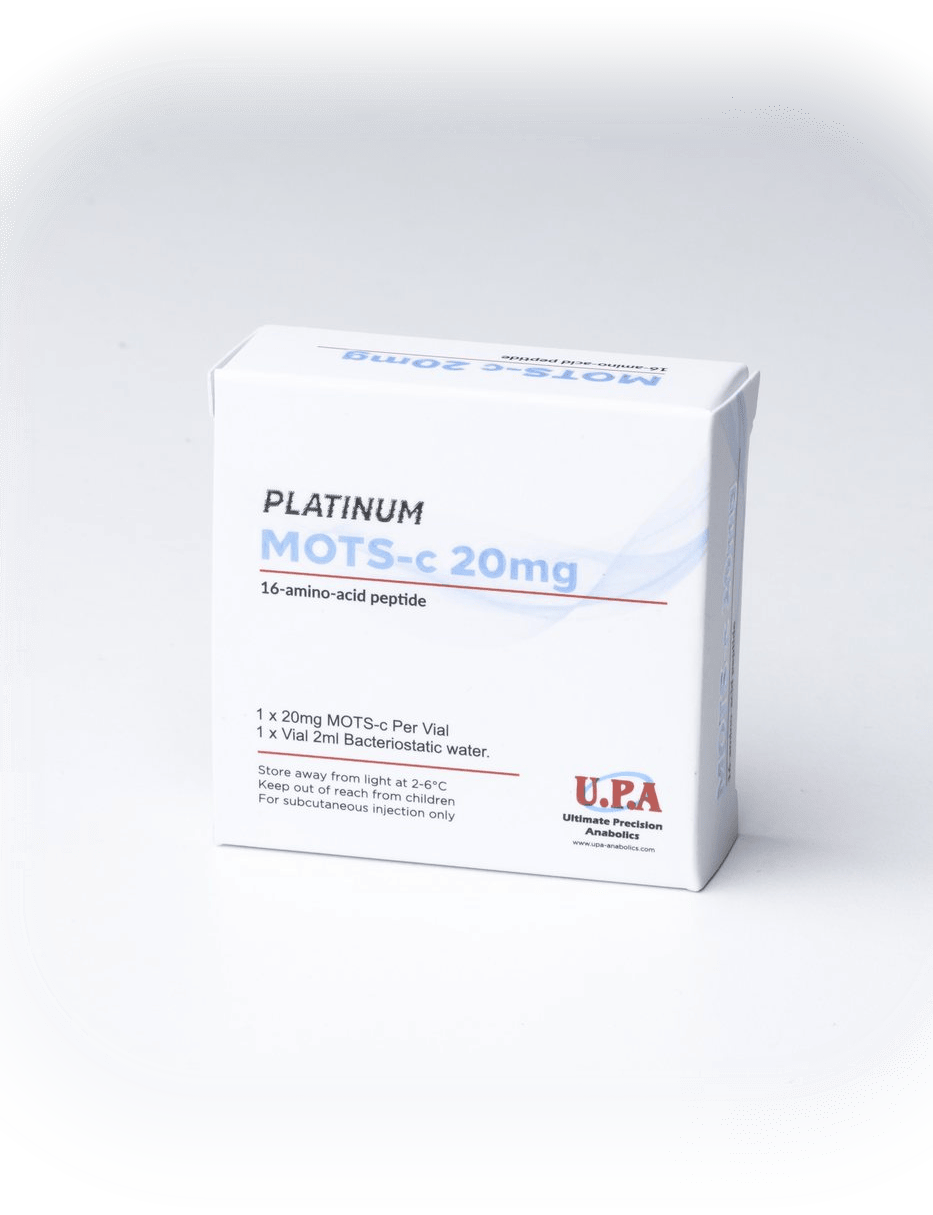
| UPA | Vial | 20mg | R500 | Order → |
MOTS-c (Mitochondrial Open reading frame of the 12S rRNA-c) is a 16-amino-acid peptide discovered in 2015 — unusually, it is encoded directly within mitochondrial DNA rather than the cell's nuclear genome, making it one of only a handful of known "mitochondrial-derived peptides." It acts as a signal from the cell's own energy centres to the rest of the body.
Endogenous MOTS-c rises roughly 12-fold in human skeletal muscle following a single bout of acute exercise, and its expression is known to decline with age — the basis for its positioning as an exercise-linked longevity signal.
MOTS-c acts on the folate cycle, inhibiting de novo purine biosynthesis and causing the intermediate AICAR to accumulate. AICAR is a potent activator of AMPK — the cell's master regulator of energy status, switched on during exercise and energy stress. Skeletal muscle is its primary target tissue, where it functions as a mitochondria-to-nucleus signal regulating glucose uptake and insulin action systemically.
| Standard dose | 5mg SC, 2–3× weekly |
|---|---|
| Timing | Morning, 30–60 min pre-exercise, fasted |
| Cycle | ~8 weeks on / 8 off |
| Route | Subcutaneous; rotate injection sites |
| Common stack | NAD+ (MOTS-c + NAD+ combo) |
Almost all efficacy data — the running-capacity and insulin-sensitivity findings above — comes from mouse studies. Exogenous (injected) MOTS-c has not yet completed a published human efficacy trial. A Phase 2a randomised, placebo-controlled trial (NCT07505745) is currently underway in adults with prediabetes and overweight/obesity, testing 12 weeks of subcutaneous MOTS-c against insulin sensitivity (Matsuda Index) over a 16-week study — results are not yet available. What is confirmed in humans is that the body's own MOTS-c rises sharply with exercise; what exogenous dosing achieves is still being tested.
MOTS-c is a research compound, not approved by the FDA for any medical use. It is banned by the World Anti-Doping Agency at all times (S4.4.1, AMPK activators) — relevant for any client subject to anti-doping testing. All use should be guided and supervised by a qualified practitioner. This sheet is for informational purposes only and does not constitute medical advice.